
Risk Management · Lesson 16 of 40
Position Sizing and the 1% Rule (With Formula)
Why most accounts die
The most common reason accounts get destroyed is not bad analysis — it's an oversized position. Imagine a trader who risks 20% of their account on every trade. Four consecutive losses leave them with 41% of the starting capital; five losses drop them to 33%. And five losses in a row is not a rare event — with a 50/50 win rate, it happens roughly once every 32 trades, and with a realistic 40–45% win rate it comes around even more often. Now do the math on the other side: after losing 67% of the account, the trader needs a 200% gain just to get back to where they started. That is the trap. The market doesn't punish you for being wrong — it punishes you for being wrong with too much size. A 1% error in your analysis is harmless if your position is small; the same 1% error can wipe out a month of profits if the position is huge. Professional traders think about survival first and profit second, because a trader who survives the bad streaks is always around for the good ones.
The 1% rule
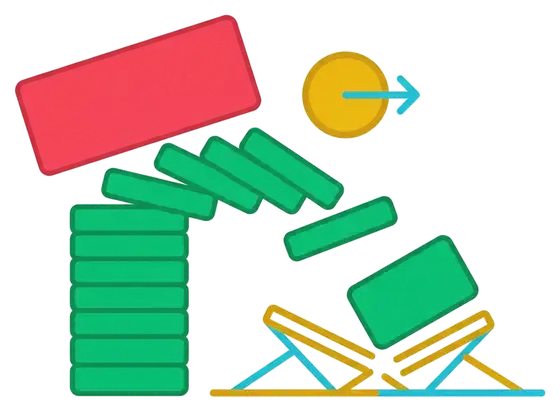
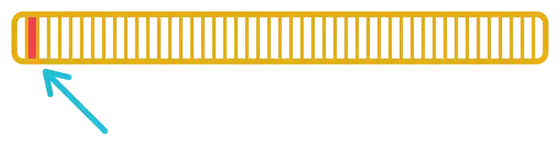
The professional standard is simple: never risk more than 1% of your account on a single trade. On a 10,000 USDT account, that means the maximum loss you accept on any trade is 100 USDT. Ten consecutive losses — a brutal but entirely possible streak — would cost you about 10% of the account: painful, but you're still in the game with 9,000 USDT and the ability to recover. Compare that with the 20% risk style above: the same ten-loss streak would leave you with 11% of your capital and a 900% recovery needed. The 1% number is not magic — aggressive professionals push to 2%, conservative ones trade at 0.5% — but the principle is universal: your risk per trade must be small enough that a realistic losing streak cannot damage your ability to keep trading. The 1% rule also forces honesty: it makes you realize how many trades are not worth taking at all. If a setup can't offer at least 2–3 times your risk in potential reward, the math says skip it.
The position size formula
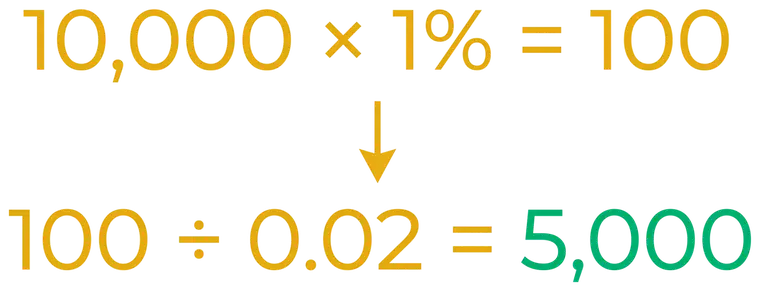
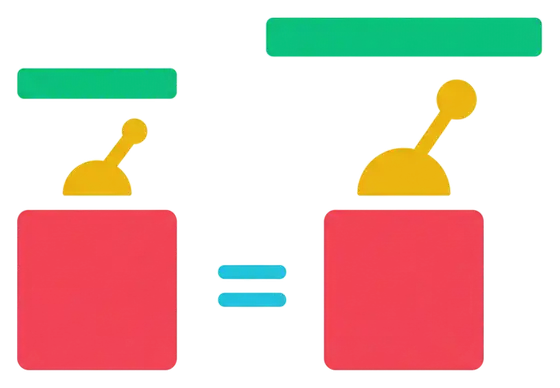
Position size = (capital × risk percent) ÷ (stop distance as a decimal). Let's do it with numbers. Capital: 10,000 USDT. Risk: 1% = 100 USDT. Stop distance: you plan to place your stop 2% below your entry. Position size = 100 ÷ 0.02 = 5,000 USDT. That's how much you can open — whether the market is Bitcoin, gold futures or the NASDAQ index. Now change one number and watch everything move: if your stop is tighter (0.5%), the formula allows a 20,000 USDT position — same risk, bigger size, because the trade is "safer" per unit. If your stop is wider (5%), the position shrinks to 2,000 USDT. This is the exact inverse relationship that beginners get wrong: they fix the position size and let the risk float. Professionals fix the risk and let the position size be whatever the formula says. The stop distance is decided by the chart (where support and resistance are), never by how much money you want to make.
Try it in the app
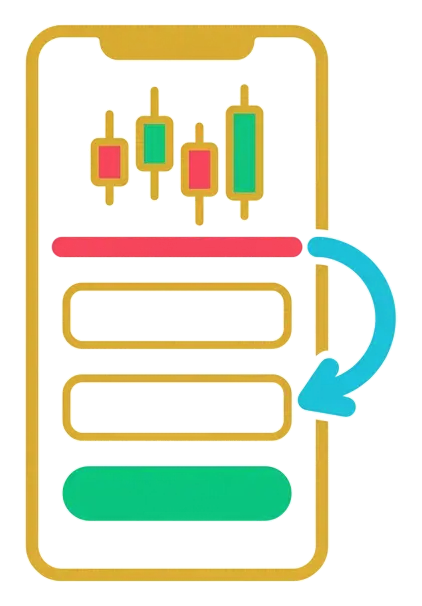
The app's Trade screen shows you the risk before you commit: enter your stop level and watch the app calculate what the trade would cost you if the stop is hit. Use it as a gate, not a formality. Before every trade, set your risk to 1% of your balance and let the app compute the position size — if the app's number differs from what you wanted to type, the app is right and your impulse is wrong. Try this experiment: on the demo account, open the same setup twice — once with the position size the calculator gives you, once with a position twice as big. The P&L moves twice as fast in both directions; the trade that "felt" better is simply the one that would hurt twice as much when wrong. Build the habit now, on fake money, because habits don't change when real money arrives — they just get more expensive. After 50 demo trades sized by the 1% rule, the calculator becomes as natural as checking the price.
Try it in Trade DojoFree on Android · virtual money
What leverage does — and doesn't do
Leverage confuses more beginners than any other concept. Here's the clean way to think: leverage does not change how much you risk — your stop loss does. If the formula says your position is 5,000 USDT and your account has 10,000 USDT, you don't need leverage at all. If the formula says 50,000 USDT and your account is 10,000 USDT, you need 5× leverage just to open it — but your risk is still only the 100 USDT between entry and stop. What leverage actually changes is the distance to liquidation: at 5× leverage, the price can move 20% against you before your margin is gone; at 20×, liquidation comes after just 5%. High leverage is not "more risk per trade" if your stop is tight — it's less room for the market to breathe before you're forcefully closed out. The professional approach: choose the leverage that lets your stop sit where the chart says it belongs, with a buffer to spare — never the maximum the exchange offers.
Quiz: test yourself
8 questions from the lesson. Tap an answer to check it.
-
Your account is 10,000 USDT and your stop is 5% away from entry. With the 1% rule, what is the maximum position size?
-
A trader risks 20% of their account on every trade and loses five times in a row. What is the result?
-
Why does the 1% rule survive losing streaks?
-
You want a 5,000 USDT position but your account has only 2,000 USDT. What do you need?
-
Your account is 10,000 USDT, you risk 1% and your stop is 2% away from entry. What is the position size?
-
You keep risking 1%, but your stop moves from 2% to 0.5% away. What happens to the position size?
-
What does leverage actually change?
-
What should decide how far away your stop loss is?
Educational content only, not financial or investment advice. Trading involves risk; all trading in Trade Dojo uses virtual money. More Risk Management lessons · All lessons