
Guide
What is paper trading? Meaning, how to start and where it falls short
Paper trading means placing simulated trades with virtual money on real market prices. Nothing you win or lose is real, which makes it the cheapest way to learn how trading works and to test whether you can stick to a plan. Here is how to do it properly, how it compares with a demo account and what it cannot teach you.
 Free · No sign-up · Virtual money only
Paper trading meaning
The name comes from the days when people practiced by writing trades down on paper: the date, the price they would have bought at, the stop and, later, the exit. Today the paper is an app that feeds you real prices, keeps a virtual balance, fills your orders and tracks the result.
Everything works like the real thing except the money: you still choose the entry, place the stop, size the position and live with the outcome.
What paper trading is good for
Learning the mechanics
Long and short, order types, leverage, margin and liquidation make sense once you have used them.
Testing a plan
Run one setup 30 or 50 times and you get real numbers on it: win rate, average win and loss, drawdown.
Building habits
A stop before every entry, fixed risk per trade, a journal note after every exit.
How to paper trade, step by step
- Pick a realistic balance. Use roughly the amount you might trade one day, not a million. Trade Dojo lets you set anything from 5 to 1,000,000 USDT; the default is 10,000.
- Choose one market and one setup. Twenty trades on one idea beat twenty trades on twenty ideas.
- Write the plan first. Entry, stop, target and the reason for the trade.
- Size by risk, not by feel. With 10,000 USDT and 1% risk, the most you lose is 100 USDT. If the stop is 2% away, the position is 100 ÷ 0.02 = 5,000 USDT. The position size calculator does the math, and position sizing explains it.
- Attach the stop and target to the order. Decide exits while you are calm, not while the trade is moving.
- Journal every trade. What you planned, what happened, what you would change. See how to keep a trading journal.
- Review every 20 to 50 trades. Check win rate, profit factor, expectancy and maximum drawdown, then change one thing at a time.
Resetting after a bad run hides the lesson. By default, Trade Dojo archives your old trades on reset instead of deleting them.
Paper trading vs a demo account
Both use virtual money; the difference is usually who provides it: a demo account is a practice version of one broker's platform, while a paper trading app is a standalone simulator.
| Trade Dojo (paper trading app) | Typical broker demo | Live account | |
|---|---|---|---|
| Sign-up | None | Usually email or phone | Full identity checks |
| Money at risk | None | None | Your own |
| Prices | Live for crypto, delayed up to 15–20 min elsewhere | The broker's feed | The broker's feed |
| Fills | Simulated, optional spread and slippage | Simulated | Real: spread, slippage, partial fills |
| Time limit | None | Varies; some expire | None |
To rehearse on one broker's platform, use its demo. To learn trading itself without handing over your details, a paper trading app is simpler.
Is paper trading worth it?
Yes, if you treat it like real trading. The common failure is doing on paper what you never would with your own money: 50x leverage on everything, no stops, a reset after every blowup. One rule keeps it honest: trade the size, leverage and frequency you would actually use.
The limits of paper trading
No real emotions
The hard part of trading is following the plan when money is on the line: holding through a normal pullback, taking a stop without moving it, not doubling up after a loss. On paper, fear and greed are muted, so a plan looks easier to follow than it is. See trading emotions and fear, greed and revenge trading.
Fills and slippage
A simulator usually fills you at the price on the screen. Real markets do not: market and stop orders pay the spread and can slip, a fast move can jump past your stop, and a limit order can be touched without filling. Trade Dojo's optional Realistic execution setting adds a bid/ask spread, slippage that grows with order size, and limit orders that fill only when price trades through the level. It narrows the gap. It does not close it.
Data, costs and size
In Trade Dojo, crypto streams live from Binance, while stocks, forex, commodities and indices are marked DELAYED and can trail the market by up to 15–20 minutes. Its fees and simulated funding will not match any real broker's. And a virtual 500,000 USDT order fills in one go, where a real one in a thin market could move the price against you.
When to move on from paper trading
There is no fixed number of days. Look at evidence instead:
- A meaningful sample: dozens of closed trades with one approach, ideally 50 or more.
- Positive results after fees, with a profit factor above 1.
- A maximum drawdown you could sit through with real money.
- A stop on every trade and no liquidations.
- A complete journal, with the same mistakes no longer repeating.
Trade Dojo's Trader Readiness score turns checks like these into a checklist. It cannot decide whether you should trade with real money; that depends on your finances and goals, and nothing in a simulator is financial advice. If you do, start with the smallest size available and expect early results to be worse than on paper.
A paper trading app without sign-up
Trade Dojo is a free paper trading app for Android with no account and no email. You get crypto, stocks, forex, commodities and indices on real prices, bracket orders with trailing stops, a journal with a P&L calendar and 40 short lessons with quizzes in nine languages. Your data stays on your phone.
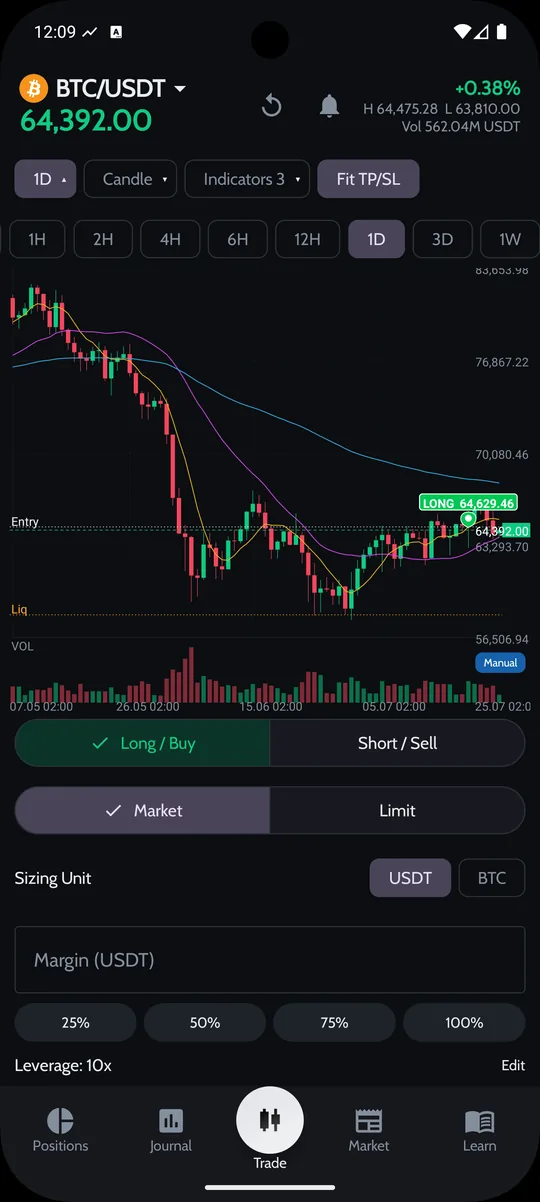
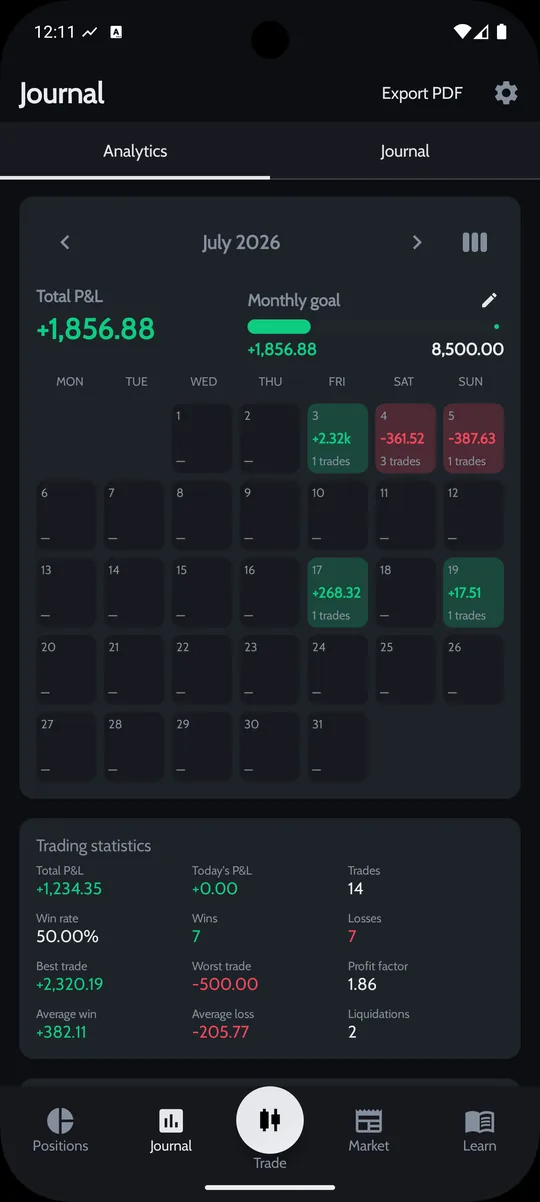
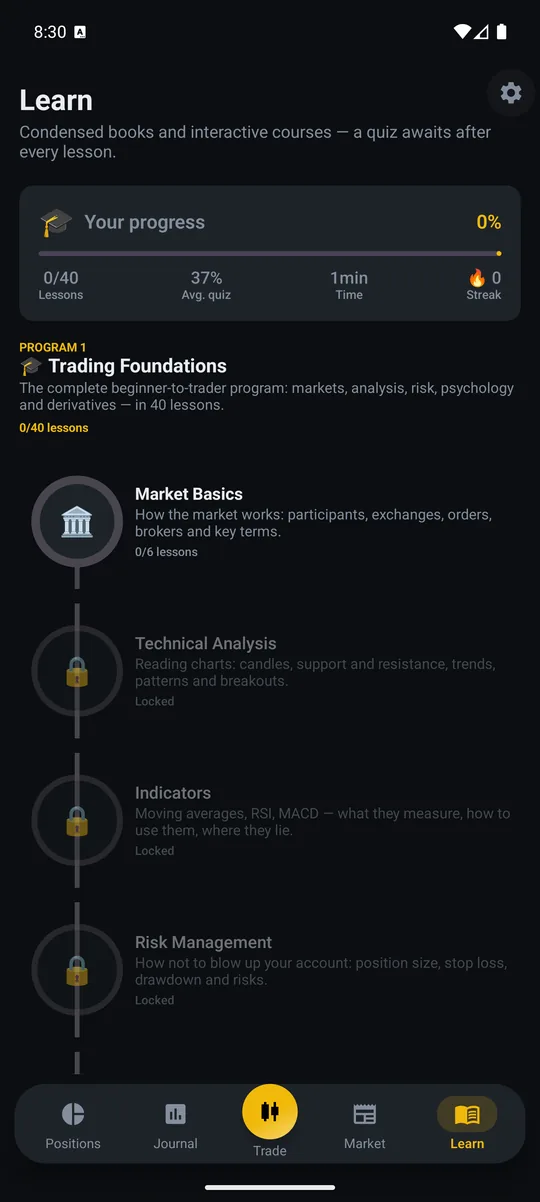
Pick a market: the crypto trading simulator, the forex trading simulator or the stock market simulator, or browse all lessons.
Virtual money only. Trade Dojo has nothing to deposit and nothing to withdraw, no prizes and no funded accounts. It is an educational simulator, not a broker.
Paper trading questions
Is paper trading the same as a demo account?
Both use virtual money on real prices. A demo account is a practice version of one broker's platform and usually needs registration; a paper trading app is a standalone simulator. Trade Dojo needs no sign-up.
Is paper trading worth it for beginners?
Yes, as long as you trade the size and leverage you would really use, put a stop on every trade and keep a journal. Treated like a game, it teaches habits you will have to unlearn.
Can you make money paper trading?
No. The balance is virtual, so there is nothing to withdraw and there are no prizes. What you gain is practice and data about your own trading.
Is there a paper trading app without sign-up?
Yes. Trade Dojo for Android needs no account or email, keeps your data on your phone and is free with ads. Install Trade Dojo from Google Play.