
Risk Management · Lesson 18 of 40
Types of Trading Risk: Market, Execution, More
Market risk: when everything falls
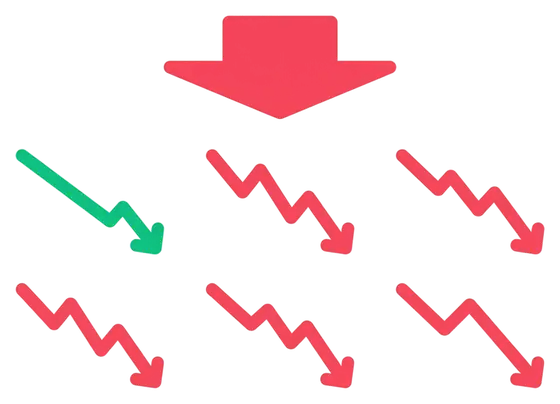
Market risk is the risk that the whole market moves against you — not because your analysis was wrong, but because everything falls together. A central bank raises rates, and Bitcoin drops 15% in a day; a war starts, and every index on the planet opens red. Your support level, your trend line, your perfect setup — all worthless, because the tide went out and every boat went with it. Market risk is unavoidable and undiversifiable in the moment: holding ten different cryptos doesn't help when crypto as a class is selling off. What you control is how exposed you are: position size (a 1% risk trade can't destroy you even in a crash), leverage (at 20×, a 5% market move is game over), and cash (the trader holding no position when the crash starts has already won that day). Professionals respect market risk the way sailors respect weather: you don't argue with the storm, you reduce sail and wait. The one tool that turns market risk from a disaster into a cost is the stop loss — it works in crashes too, sometimes with slippage, but it works.
Instrument risk: not all markets are equal
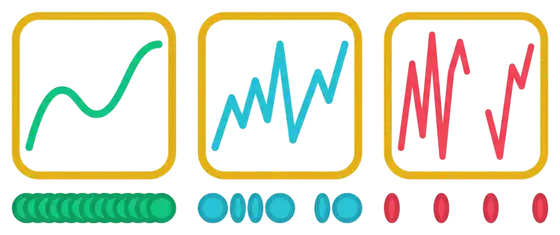
Instrument risk lives inside the thing you trade. Liquidity risk: a small altcoin with thin order books can gap 10% on nothing, and your stop order may fill far from its level. Volatility risk: an instrument that moves 5% a day can hit your stop with a normal breath of air; the same setup on a calmer pair survives. Spread risk: on liquid majors the spread is a rounding error, on exotics it can be a real cost per round trip. And then there's the structural stuff: contract expiry in futures (the price converges and your position needs rolling), funding in perpetuals, or a stock that gets halted mid-move. The professional answer is selection, not luck: trade instruments where the risk is predictable. For your first year, that means the majors — BTC, ETH, the S&P and NASDAQ futures, gold, EUR/USD — and nothing with a spread over a few basis points. The exotic stuff will still be there in year two, and by then you'll know exactly what you're paying for.
Execution risk: the gap between plan and fill
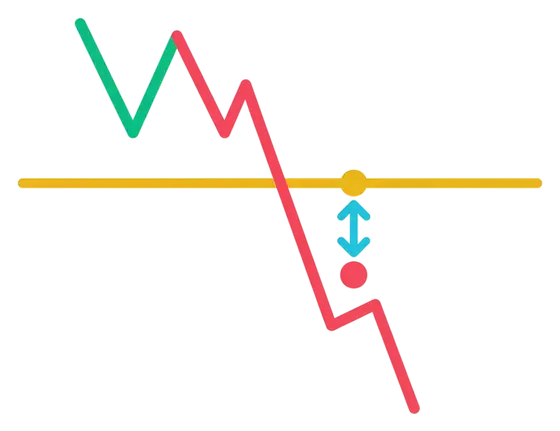
You placed the stop at 29,500; the market crashed through it and your order filled at 29,150. That difference — slippage — is execution risk. It appears in fast markets, thin books and around news: the price moves so quickly that orders fill at worse prices than the level, or not at all. Execution risk also includes platform failures: an exchange that freezes during a spike, a feed that lags, an order that "times out" and leaves you thinking you're protected when you're not. You can't eliminate execution risk, but you can shrink it. Trade liquid instruments — slippage on BTC futures in a normal session is tiny; on a dead altcoin it can be brutal. Use limit orders where speed doesn't matter — a limit entry can't slip, by definition. Keep stops on the exchange (not on your phone's app that might be closed). And never trade through high-impact news with a position you can't afford to see filled at a worse price — that's exactly when the market moves fastest and the order book is thinnest. Plan for the fill you'll get, not the fill you hope for.
Liquidation risk: the futures special
On leveraged products, there's a risk with no equivalent in cash trading: liquidation. Your position uses margin; when losses eat the margin, the exchange force-closes you — often exactly at the worst moment, because liquidation cascades feed on themselves. The math is brutal and simple: with 10× leverage, a 10% move against you is a 100% loss of your margin. With 20×, it's a 5% move. Liquidation risk is the reason leverage deserves respect: it's not a multiplier of profit, it's a deadline on your breathing room. Two tools keep you safe. First, never size a leveraged position larger than your risk formula allows — the position that "needs" 20× is usually a position too big for the trade. Second, understand isolated vs. cross margin (detailed in the futures course): isolated margin limits a liquidation to the one position; cross margin lets losses spill across your whole account. In the app, open a leveraged demo position and read the liquidation price it shows you — that number is your true stop, and it should always be farther away than your actual stop.

What you actually control
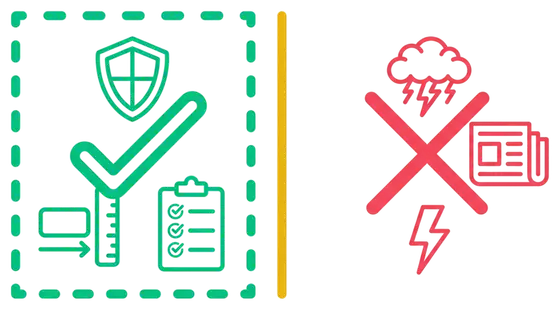
List the risks and a pattern appears: the ones that hurt beginners most are exactly the ones they ignore, and the ones they fear most are mostly out of their hands. Market risk — you control your exposure, not the market. Instrument risk — you control your selection. Execution risk — you control your orders and your timing. Liquidation risk — you control your leverage and size. And then there's the fourth category, the one that ends more accounts than all the others combined: you risk. The decision to revenge-trade after a loss, to move a stop, to average down, to "just check one more candle" at 2 AM. No exchange can liquidate you faster than your own discipline can. The practical routine: before every trade, write down the four numbers — entry, stop, target, size — and the risk type you're most exposed to. If you can't name the risk, you haven't looked at the trade properly. If you can, you're already ahead of most of the market, because most of the market never looks.
Quiz: test yourself
8 questions from the lesson. Tap an answer to check it.
-
Which risk is reduced by trading liquid instruments like BTC or gold futures?
-
At 20× leverage, a 5% move against your position causes...?
-
A central bank raises rates and every crypto drops 15%. Your long was stopped out. What kind of risk hit you?
-
Which of these is fully under your control?
-
Your stop is at 29,500, but during a crash it fills at 29,150. What is this?
-
Which order type cannot slip on entry, by definition?
-
What does isolated margin do?
-
Where should the liquidation price of a leveraged position be?
Educational content only, not financial or investment advice. Trading involves risk; all trading in Trade Dojo uses virtual money. More Risk Management lessons · All lessons