
Beginner Mistakes · Lesson 24 of 40
5 Costly Beginner Trading Mistakes to Avoid
Catching falling knives
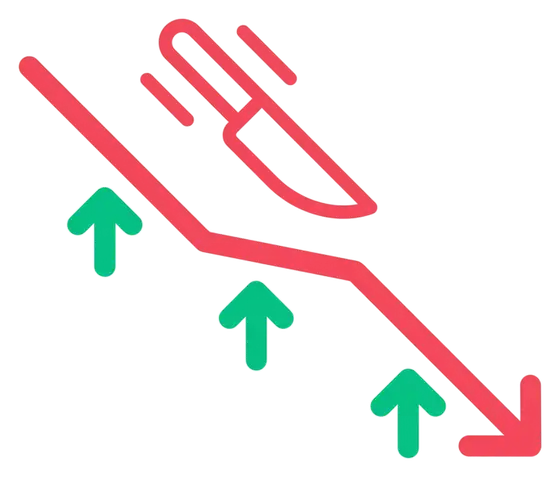
The falling knife is a market in freefall — and the beginner's instinct is to buy it, because "it's cheap now". The math of the instinct: a coin that fell 30% and falls another 30% is down 51% from the original price — the "bargain" at −30% was still a trap. Falling knives have no handle: there is no way to know where the fall stops, and every "it must bounce here" is a guess dressed as a conviction. The professionals' relationship with falling markets is patience: they wait for the fall to END, and they know a fall ends not when it's cheap, but when the structure turns — a higher low after the selling climax, a break of the falling trend line, a first close above the last crash's high. The price that looks cheap today often looks expensive next month. In the app, find a coin that crashed and check the chart honestly: has the structure turned, or is it still making lower lows? The answer to that one question separates a value trap from an opportunity — and beginners almost always answer it wrong.
Trading against the dominant trend
The second most expensive habit is fighting the bigger picture: buying the daily downtrend because the 1H chart "looks oversold", or shorting a powerful uptrend because "it's gone up too much". The market doesn't care how far it's gone — trends extend far beyond what feels reasonable, and the trader fighting the trend is fighting the combined weight of every participant. The technical definition from earlier courses does the work: the daily chart says lower highs and lower lows — every long is a trade against the current, and against the current, even good entries lose. The fix is a filter, not a feeling: before any trade, check the higher timeframe and write down its direction. If the 1H setup says buy but the daily says down, the honest conclusion is "no trade" — not "smaller buy". The trend is not a suggestion; it's the tide, and the tide decides which boats float. Professionals don't fight the tide; they wait for it to turn, and they turn with it.
Winging it — no plan, all feelings
The third mistake is the absence of a plan: entering because the chart "looks good", because a friend mentioned it, because the fear of missing out is loud. A trade without a written plan — entry, stop, target, size — is not a trade, it's a gamble with extra steps, and the house (the market, the fees, the emotions) always wins gambles in the long run. The winging-it trader has no target, so every small profit is tempting and every loss is ambiguous; they exit winners too early, hold losers too long, and size everything by mood. The fix is the checklist from the psychology course, applied literally: trend, level, trigger, stop, target, size, event risk — seven boxes, all filled before the ticket opens. The plan doesn't need to be clever; it needs to exist. A mediocre plan followed consistently beats a brilliant plan improvised badly, every time — because the mediocre plan can be measured, learned from, and improved, while improvisation teaches nothing and repeats everything.

Averaging down: adding to a loser
Averaging down means buying more of a losing position to lower the average entry price — and it feels so reasonable: "now it's cheaper, my average improves, and it just needs a small bounce". The math exposes the trap: you buy 1 BTC at 30,000, it falls to 24,000, you buy another 1 BTC. Your average is now 27,000 — the price must rise 12.5% just to break even, and you've doubled your exposure to a position that is already proving you wrong. The deeper problem is what averaging down does to the account: it turns a position problem (this trade is wrong) into an account problem (half my capital is now in a falling market), and it does it exactly when discipline matters most. The professional rule: add only to WINNERS, according to a plan, never to losers. A loser is a fact — the market is telling you the trade is wrong, and the correct response is not to buy more of the wrong answer. The people who blew up accounts didn't lose on the first trade; they lost on the tenth addition to it.

Ignoring the stops
The fifth mistake is the one that converts all the others into catastrophes: not honoring the stop loss. The stop was placed for a reason — the level that made the trade valid was violated, and the plan said leave. But the trader looks at the open loss, feels the pain, and decides "just a little more" — and by that decision, the exit moves from the plan to the market's mercy. The stop ignored once becomes a stop ignored always: the trader who won't take a 2% loss will eventually be forced to take a 15% one, at the worst possible moment, usually by liquidation. The honest reframe: the stop is not a prediction — it's a commitment. You agreed to the loss when you opened the trade, the loss is the price of being wrong, and being wrong is a normal event, not an emergency. The emergency is only when the commitment is broken. Professional traders take their stops like clockwork, hundreds of times a year, and the reason they can is simple: they know the loss was already budgeted, and the next trade is already waiting. The stop is not the end of the story — it's the page turn.
Quiz: test yourself
8 questions from the lesson. Tap an answer to check it.
-
You buy 1 BTC at 30,000, it falls to 24,000, and you buy another 1 BTC. What is your new average price?
-
A coin falls 30%, then falls another 30%. What is the total decline from the original price?
-
Which position should you add to, according to the professional rule?
-
A trade hits your stop level. The correct action is...?
-
Your average price is 27,000 after buying at 30,000 and 24,000. From 24,000, how much must the price rise just to break even?
-
According to the lesson, when does a falling market really end?
-
The 1H chart says buy, but the daily chart is in a downtrend. What is the honest conclusion?
-
Why is averaging down dangerous?
Educational content only, not financial or investment advice. Trading involves risk; all trading in Trade Dojo uses virtual money. More Beginner Mistakes lessons · All lessons