
Futures & Derivatives · Lesson 40 of 40
Crypto Perpetual Futures and Funding Explained
What a perpetual is
A perpetual swap is a futures contract with no expiry date. Regular futures have a settlement day — the quarterly BTC future closes four times a year, and traders must close or roll. The perpetual simply never ends: you can hold a position for five minutes or five months, and the only thing that changes is the funding payment (next section). This one design decision made perpetuals the most popular crypto product in the world: no expiry to manage, no rollover to calculate, just the pure leveraged bet on the price, forever. In the app, the BTC and ETH perpetuals are the instruments you'll trade most: same charts, same order types, same margin and liquidation mechanics as the quarterly futures you just learned — minus the calendar. The perpetual's price tracks the underlying spot price through the funding mechanism, and understanding that mechanism is the difference between knowing how to click the button and knowing how the market actually works.

Funding: the anchor to spot
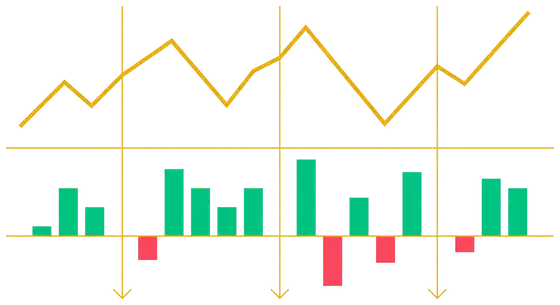
Perpetuals solve the "no expiry, no convergence" problem with funding. Every few hours (usually every 8 hours), longs and shorts exchange a payment: when the perpetual's price trades above the spot price, longs pay shorts (positive funding — the market is crowded long); when it trades below, shorts pay longs (negative funding). The rate is small — typically 0.01% per payment — but it's the mechanism that keeps the perpetual's price anchored to the real market instead of drifting away. The practical consequences: funding is a cost of holding — a 0.01% rate three times a day is about 0.09% per three days, real money on a large position held for weeks; and funding is a sentiment gauge — extreme positive funding means the crowd is extremely long, a classic contrarian warning, while deeply negative funding marks crowded shorts. Check the funding rate before opening any position you plan to hold longer than a day; the market is literally telling you which side is paying rent.
The 24/7 market: opportunity and nightmare
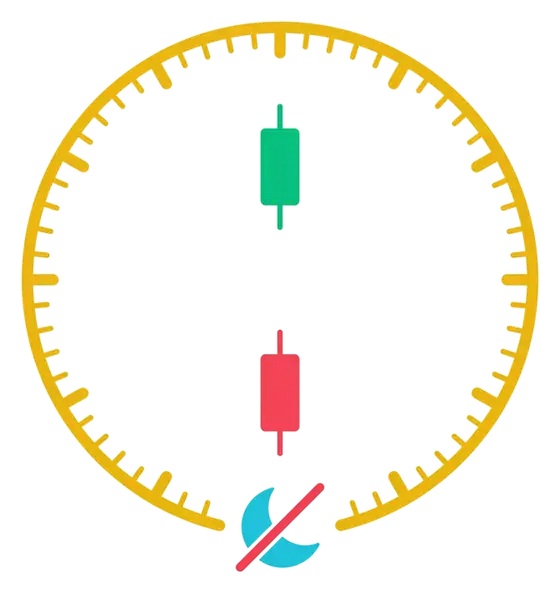
A market that never closes is a double-edged sword. The opportunity: no gaps from one session to the next, no "waiting for the open" — news hits at 3 AM, and you can act at 3 AM. The nightmare: the market is thinner at 3 AM — fewer orders, wider spreads, and moves that a daytime crowd would absorb can run wild. Add leverage, and the combination produces the famous crypto events: a flash crash that liquidates tens of thousands of leveraged positions in minutes, then recovers just as fast — with the liquidated accounts not coming back. The rules that keep you alive in the 24/7 market: avoid the dead hours (check the volume bars — trade when the market is awake); never hold maximum leverage into the weekend; and treat every liquidation wall as a warning — when a cascade is visible on the order book, the market is about to move violently in the direction that kills the crowded side. The 24/7 market doesn't sleep, so your risk management has to be awake instead.
Perpetuals in the app
The app's Trade screen is built around the perpetual: BTC/USDT and ETH/USDT perpetuals with leverage up to the exchange's maximum, the same TP/SL/OCO tools you already mastered, and the liquidation price displayed on every ticket. The trading is identical to everything you've learned — trend, levels, triggers, the 1% rule — with two adjustments for the perpetual's nature. First, the pace: 24/7 liquidity means setups form and resolve faster than on daily-chart stocks; the 4H chart on a perpetual behaves like a fast-moving daily chart. Second, the costs: every position pays fees on entry and exit, and positions held through funding pay the rate — both are small, and both must be in your calculations. Use the demo to build the full routine: check funding, check the session's liquidity, size by the 1% rule, attach TP and SL before entry. When the routine is automatic in the demo, the same routine will carry you in the real market — that's the entire point of the app.
Try it in Trade DojoFree on Android · virtual money
Why beginners lose the most right here
Perpetuals combine the three things that destroy beginners: maximum available leverage, 24/7 temptation, and a market that moves fast. The exchange will happily offer you 100× — it's a button on the ticket — and the beginner clicks it because a 2% move "would double my money". The math they skip: a 1% adverse move also halves it, and the liquidation price sits 1% away. Add the 24/7 schedule and the result is a casino with better graphics: overtrading at 2 AM, revenge trades after liquidations, and positions sized by hope instead of the formula. The countermeasures are the same rules you've already written down — risk 1%, stop closer than liquidation, no trading in dead hours, no trading after losses — but here they matter most, because this is the market that punishes every mistake immediately and completely. The professionals who trade perpetuals profitably treat them as ordinary futures with extra volatility: same plan, same size, same discipline. The instrument doesn't change the rules; it just raises the stakes.
Quiz: test yourself
8 questions from the lesson. Tap an answer to check it.
-
Your position is 10,000 USDT and the funding rate is 0.01% every 8 hours. What is your daily funding cost?
-
What keeps a perpetual's price anchored to the spot price?
-
Positive funding means...?
-
Why do beginners lose the most on perpetuals?
-
The perpetual trades below the spot price. Who pays funding?
-
What is extremely positive funding a classic warning of?
-
With 100× leverage, roughly how far away is the liquidation price?
-
Which rule helps you survive the 24/7 market?
Educational content only, not financial or investment advice. Trading involves risk; all trading in Trade Dojo uses virtual money. More Futures & Derivatives lessons · All lessons