
Risk Management · Lesson 20 of 40
ETFs Explained: Pros, Cons and Leveraged ETFs
What an ETF is
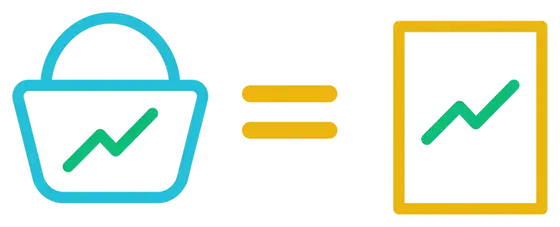
An ETF (exchange-traded fund) is a basket of assets that trades like a single stock. One order buys you a slice of the whole basket: an S&P 500 ETF holds 500 companies, a gold ETF holds physical gold, a sector ETF holds the banks or the tech giants. You buy and sell ETF shares on an exchange, at market prices, with the same order types you already know — limit orders, stop losses, all of it. The power is instant diversification: instead of researching 500 companies, you buy one product that tracks all of them, and one bad company in the basket barely dents your position. That's the core appeal — for the price of one trade you get the average performance of an entire market or sector, without the risk of picking the one stock that collapses. ETFs are also cheap: management fees are typically a fraction of a percent per year, and there are no entry barriers — you can start with the price of one share.
The honest pros and cons
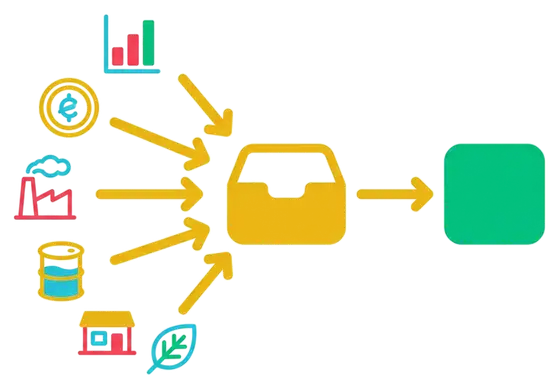
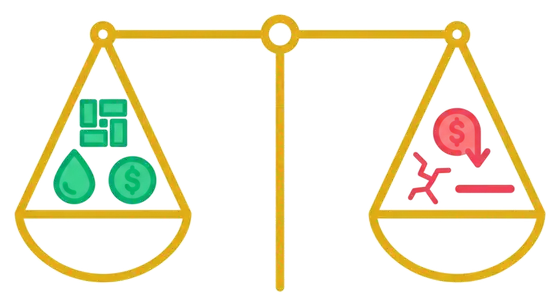
The advantages are real: diversification (one bad stock can't sink you), liquidity (major ETFs trade like the biggest stocks), transparency (you can see the holdings daily), and low cost. But the cons deserve equal time. First, an ETF protects you from single-stock disaster but not from market risk — when the whole market falls, the ETF falls with it, because it IS the market. Second, tracking error: the fund doesn't perfectly match its index — small fees and timing differences add a small drag. Third, diversification is a trade-off: a broad ETF will never give you the 10× return of the one stock that rockets — you've traded away the chance of a huge win for the safety of an average. Fourth, the ETF wrapper can trade at a premium or discount to its underlying value in stressed markets. The balanced view: ETFs are not a magic product, they're a choice — you are choosing average performance with low risk of disaster over the lottery ticket of individual picks. For a beginner, that choice is usually the smart one.
The three families
ETFs come in different construction styles, and the style changes the behavior. Market-weighted ETFs hold more of the big companies and less of the small ones — the S&P 500 ETF is dominated by its largest members, so it behaves like the big tech names in disguise. Equal-weighted ETFs give every company the same slice — smaller companies matter more, and the fund behaves differently (often more volatile, sometimes better in certain cycles). Fundamentally weighted ETFs weight by business metrics like earnings or dividends instead of price — a value-flavored approach that tends to lag in speculative markets and hold up better in crashes. Which one matters for you? For learning the market, a market-weighted index ETF is the baseline — it IS the market everyone talks about. For hedging or sector rotation (the strategy in the fundamentals course), sector ETFs are the tool: you rotate into energy ETFs early in the cycle, into tech later, into defensive sectors in recession. The ETF world is a shelf of building blocks; the strategy is yours.

Leveraged and inverse ETFs: read the fine print
The most dangerous products on the shelf are leveraged and inverse ETFs. A 2× ETF aims for double the DAILY return of its index; an inverse ETF aims for the opposite daily return. The catch is in the word "daily": the product resets every day, and the math of daily compounding means the long-term return is NOT double the index. The classic example: the index falls 10% one day, then rises 10% the next — it's back to 100. A 2× ETF: day one −20%, day two +20% — from 100 to 80 to 96. The index recovered fully; the leveraged ETF is still 4% down, forever, no matter what happens next. Hold it long enough and the decay compounds: leveraged ETFs are designed to be traded for days, not held for months. This is the single most misunderstood product in retail trading — people buy "double the Nasdaq" expecting double the long-term return and get a product that bleeds sideways. If you trade them, trade them like futures: short holding periods, stops, and full awareness that you're betting on daily moves, not the market's direction.

ETFs and the futures trader
You trade futures — so why learn ETFs? Because ETFs and index futures are two wrappers around the same market, and each tells you something about the other. The S&P 500 ETF (SPY) tracks the same index as the ES futures contract; the NASDAQ-100 ETF tracks the same index as the NQ contract. The futures contract moves faster, trades nearly 24 hours and offers leverage; the ETF trades in stock hours, settles like a stock, and holds its value without funding costs. Professionals watch both: the futures price leads the ETF during off-hours, and the ETF's volume and premium/discount give clues about retail sentiment at the open. The deeper lesson is risk architecture: an ETF position is a simple, unleveraged exposure — the reference point against which you can measure whether your leveraged futures position is actually adding value or just adding risk. If you can't explain why the leveraged version is better than the plain ETF for your goal, you probably shouldn't be in the leveraged version.
Quiz: test yourself
8 questions from the lesson. Tap an answer to check it.
-
The index falls 10% one day and rises 10% the next. What happens to a 2× leveraged ETF over those two days?
-
What is the main advantage of a broad ETF?
-
An S&P 500 ETF is market-weighted. What does that mean?
-
An inverse ETF aims to...?
-
Does a broad ETF protect you from market risk?
-
What is tracking error?
-
How long are leveraged ETFs designed to be held?
-
Which futures contract tracks the same index as the S&P 500 ETF (SPY)?
Educational content only, not financial or investment advice. Trading involves risk; all trading in Trade Dojo uses virtual money. More Risk Management lessons · All lessons