
Strategies · Lesson 29 of 40
Swing Trading for Beginners: Trend, Range, Risk
What swing trading is
Swing trading is the middle path: positions held for days — sometimes a few hours, sometimes two weeks — riding medium moves between swing highs and swing lows. It's the most practical style for a part-time trader: you analyze on the daily and 4-hour charts, place your orders, and let the market work while you sleep, study or do your job. The swing trader's questions are always the same: where is the level, where is the trigger, where is the stop, where is the target? The answers come from the tools already in your toolbox — trends, support and resistance, patterns, R:R — applied on the 4H and 1D charts instead of the 1-minute. The swing style is also the best classroom: the trade takes days to develop, so you have time to watch the story unfold, review your decisions while they're still fresh, and learn from every entry without the adrenaline of the 1-minute chart. Most professionals started here, and most of them would tell you it's the right place to stay for a long time.
Trading the trend
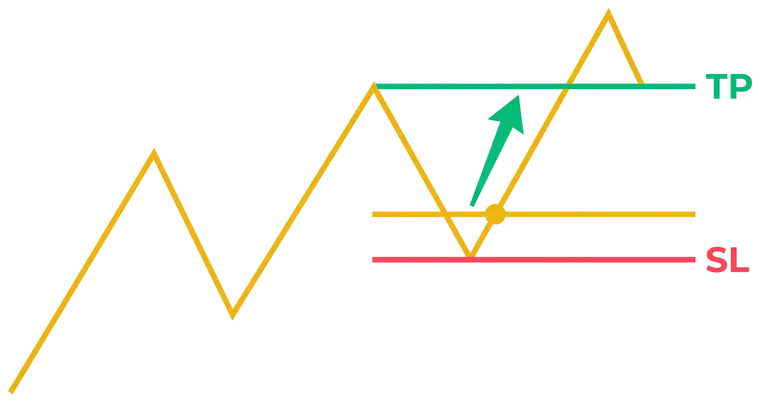
In a swing trend trade, you're buying a pause in the story. The daily chart shows an uptrend; price pulls back to the rising trend line or the 50 EMA; the 4H chart shows the pullback stabilizing; you enter with a stop beyond the level and a target at the previous high. Example: entry 1,500, stop 1,470 (below the pullback low), target 1,560 (the prior swing high) — risk 30, reward 60, a 1:2 trade with the trend.
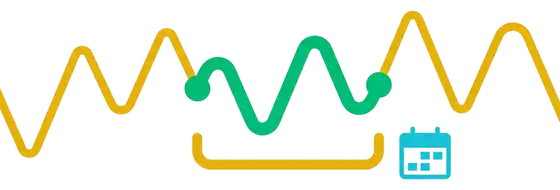
The swing version of the trend trade has one extra rule: check the calendar. A swing position lives for days, so it will survive through news events — a rate decision or CPI release mid-trade can gap through your stop or your target. Decide in advance: either widen nothing and accept the event risk, or close before the event and re-enter after. The trend gives you the direction, the pullback gives you the price, and the calendar keeps you from getting surprised — the three legs of every swing trade.
Trading the range
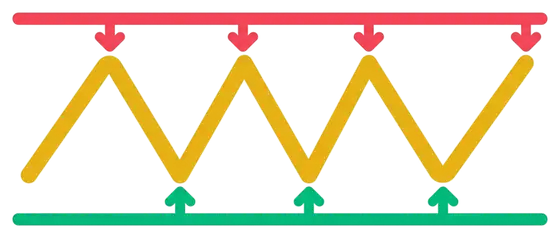
Not every market trends — and the range is the swing trader's second home. When price is bouncing between a clear support and resistance, the trade is mechanical: buy near support, sell near resistance, stop beyond the level, target the opposite wall. Example: a pair ranging between 1.0800 and 1.1000; you buy at 1.0820 with a stop at 1.0770 and a target at 1.0980 — risk 50, reward 160, a 1:3.2 trade, repeated every time price returns to the zone. The range rules from the technical analysis course apply: take profits at the opposite wall, keep size small near the edges, and the moment price closes beyond a level with volume — the range is over, switch to breakout mode. Ranges end without warning, and the trader who keeps buying the old support after it broke pays for the lesson. The range is a gift that expires; treat it like one.
Trading volatility
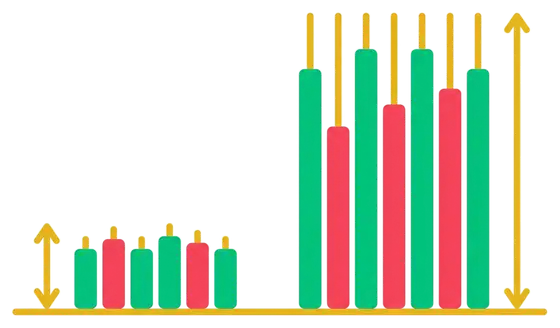
Some instruments pay swing traders simply for being wild. Volatility products — energy futures, the VIX, volatile crypto — make bigger swings in both directions, and a swing system that targets moves can profit from the size of the waves, not just their direction. The rule that makes volatility tradable: volatility sets your distance, and distance sets your size. If an instrument routinely moves 5% in a day, a 2% stop is noise — widen the stop to the instrument's normal breathing, and shrink the position so the wider stop still risks only 1% of the account. The formula never changes: position = risk ÷ stop distance. A volatile market with a wide stop and a small position is the same risk as a calm market with a tight stop and a big position — the difference is how often you get stopped out by noise. Trade the volatility that fits your risk budget, never the volatility that fits your dreams.
Swing money management
The swing style lives or dies on the weekly review. The numbers to watch: your win rate, your average winner vs. loser, your maximum drawdown, and your rule-following percentage. The standards to aim for: 1% risk per trade, a 1:2 minimum R:R on every setup, no more than two or three open positions at once (correlated positions — two crypto longs — count as one risk), and a hard weekly stop: −5% and the week is over. The swing trader's edge compounds slowly — that's the point: slow, boring, repeatable. A consistent 2% monthly return compounds to about 27% a year — and consistency at that level beats the lottery tickets most beginners buy. In the app, run a swing simulation: pick a pair, define the level-based plan, set the orders, and let them work for a week without touching the screen — then review what the journal says. The market rewards patience with interest.
Quiz: test yourself
8 questions from the lesson. Tap an answer to check it.
-
You enter a swing trade at 1,500 with a stop at 1,470 and a target at 1,560. What is your R:R?
-
A pair ranges between 1.0800 and 1.1000. Price is at 1.0820. What does the range playbook say?
-
A volatile instrument moves 5% per day. How does a swing trader adapt?
-
Why does a swing trader check the economic calendar before entering?
-
A pair ranges between 1.0800 and 1.1000. You buy at 1.0820, stop at 1.0770, target 1.0980. What is the risk:reward?
-
You hold a BTC long and an ETH long at the same time. How should you count them for risk?
-
What hard weekly stop does the lesson suggest for a swing trader?
-
A steady 2% monthly return compounds to roughly how much per year?
Educational content only, not financial or investment advice. Trading involves risk; all trading in Trade Dojo uses virtual money. More Strategies lessons · All lessons