
Market Basics · Lesson 2 of 40
Types of Traders: Scalping, Day, Swing, Position
Position trading: the long game
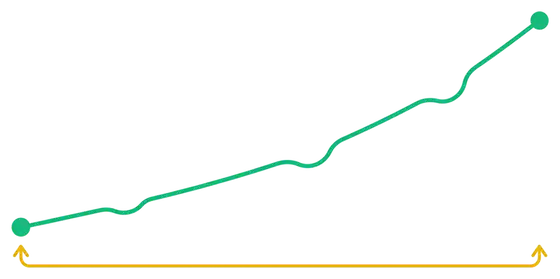
Position traders hold from weeks to months. They ignore intraday noise and focus on the big trend: if the macro picture says gold is in a bull market, they buy and hold through pullbacks, adding on dips and only exiting when the trend breaks. This style needs the least screen time — a few checks a day, a decision once a week. The risk is different: your open position can sit through deep temporary drawdowns, and you need patience and trust in your analysis. A position trader in gold during 2022–2024, for example, had to watch price move against them for weeks at a time before the bull trend resumed — the analysis was right, but the stomach had to be stronger than the chart. Position trading works well with fundamental analysis — economic cycles, central bank policy — because those forces move prices over months. For a beginner with a day job, this is usually the most forgiving style. The app's longer timeframes (4H, 1D, 1W) are your main tools here, and the bigger your timeframe, the more carefully you must choose entries — a 3% error on a weekly chart can be a 30% error on a 5-minute chart.
Swing trading: catching waves
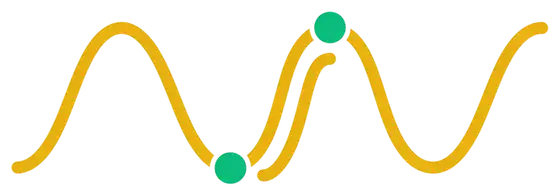
Swing traders hold for a few days — sometimes a few hours, sometimes two weeks. The goal is a medium move: from a support level to a resistance level, from a trend pullback to the next swing high. Swing trading is the most popular style for part-time traders because it fits a normal life: you can analyze in the evening, set your orders, and let the market work while you sleep. A classic swing example: EUR/USD bounces off 1.0800 three times, so you buy with a stop below 1.0770 and a target at the resistance zone near 1.0950 — the whole trade lasts about a week. Stop losses are wider than a day trader's but tighter than a position trader's. The skill to learn is timing: identifying a level, waiting for a confirmation candle, entering with a stop just beyond the level, and targeting the opposite level. Most lessons in this course are built around swing-style thinking — support, resistance, risk:reward — because it's the clearest way to learn the mechanics. In the app, try a swing trade on the 4H chart of BTC/USDT: find a support level, place a limit order above it, and set a stop below it.
Day trading: all in, all out
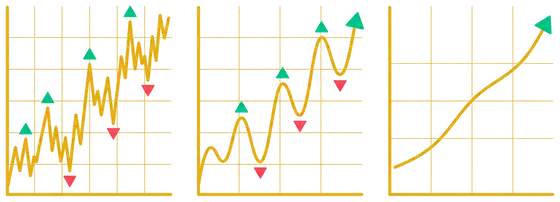
Day traders open and close every position within a single session. No position survives the night, so there is no overnight gap risk — but the day is intense: decisions are made in minutes, and costs (spreads, fees, slippage) eat a much bigger share of each small move. Day trading demands focus, speed and, honestly, a lot of screen time. It also demands self-control: a day trader makes many trades, so a single emotional trade is a bigger percentage of the day's result. In stocks, day trading is restricted by rules like the pattern day trader (PDT) rule, which requires a minimum account size — in the US it's $25,000 — while crypto and futures markets have no such restriction, which is one reason they attract day traders. If you're new, don't start here. Learn the analysis on daily charts first, then test day trading on the demo account for at least a month. The chart below shows why: the same market looks completely different depending on the zoom — on the 1-minute chart it's noise, on the daily chart it's a story.
Scalping: seconds at a time
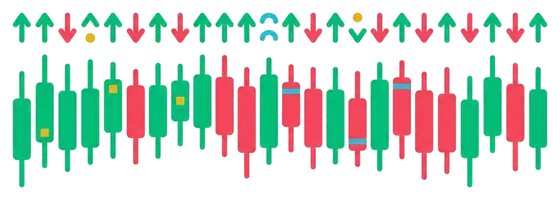
Scalpers hold for seconds to minutes, hunting tiny price differences — a few ticks per trade, dozens or hundreds of times a day. It is the hardest style: the edge is measured in fractions of a percent, costs matter enormously, and the market structure (spread, liquidity, order book) matters more than any analysis. A 0.05% fee can erase a scalper's entire edge if the move is only 0.1%. Scalping is not a "faster version" of trading — it's a different business, closer to market-making than to analysis. The math is brutal: if your average winner is 0.15% and your average loser is 0.15%, you need more than a 50% win rate just to cover fees — which is why most scalpers who survive trade extremely liquid instruments with near-zero fees. Very few beginners survive scalping, not because they're unlucky but because the math is against them. If you're curious, try it in the demo app — but treat it as research, not as your main style. Most professional traders start with swing or position trading and only add scalping after years of consistent results.
When the market is awake
Markets have a rhythm, and your style should match it. The forex and futures sessions follow the world's business day: Tokyo opens first, then London, then New York — the London–New York overlap (roughly 14:00–17:00 Central European Time) is when most volume happens and moves are cleanest. Stocks trade during their home exchange's hours — 15:30–22:00 CET for the US. Crypto is the exception: 24/7, 365 days, with the same liquidity at 3 AM as at 3 PM (slightly less in practice). Knowing the rhythm protects you in two ways. First, you avoid trading through dead hours where spreads widen and fake moves appear. Second, you know when news can hit: the US jobs report, the Fed's rate decision and CPI land at specific times and routinely cause the biggest moves of the month. A swing trader can simply avoid opening new positions right before major events; a day trader must know the calendar by heart. In the app, watch the volume bars across a day on BTC/USDT — you'll see the rhythm with your own eyes.
Which one fits your life
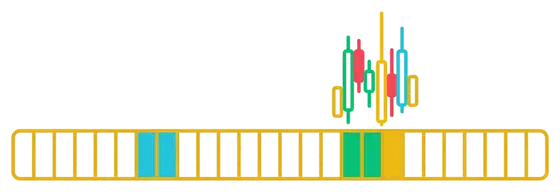
The best style is the one you can actually do consistently. Ask three questions. How much time do I have per day? Ten minutes of screen time → position trading; an hour → swing; all day → day trading or scalping. How disciplined am I under stress? If one losing trade makes you want to "fix it" immediately, shorter timeframes will punish you faster. What's my goal? Steady growth → swing or position; full-time income → day trading (with a much bigger account and preparation). There's no shame in starting slow: many professionals begin with swing trading, learn risk management, and only then shorten their timeframe. Also remember that styles mix: a swing trader can day-trade occasionally, but a beginner should master one style first. Pick one, trade it on the demo account for 30 trades, review the journal — then decide if it fits. The market will still be here next month. And when you do switch styles, keep the same risk rules — the timeframe changes the charts, not the mathematics of survival.
Quiz: test yourself
8 questions from the lesson. Tap an answer to check it.
-
A trader opens a position on Monday and closes it on Thursday. Which style is this?
-
Which style has the smallest edge per trade, so costs matter most?
-
You have a full-time job and can only check charts 20 minutes a day. Which style suits you best?
-
A day trader makes 10 trades with 10 USDT total fees. Each winning trade nets 8 USDT. If 6 trades win, what is the net result?
-
Which style never holds a position overnight?
-
When does most of the forex volume happen?
-
In the US, what minimum account size does the pattern day trader (PDT) rule require for day trading stocks?
-
A scalper's average winner and average loser are both 0.15%. What win rate do they need?
Educational content only, not financial or investment advice. Trading involves risk; all trading in Trade Dojo uses virtual money. More Market Basics lessons · All lessons